A “Research Only” Sticker Never Spotted Anybody in the Gym. Don’t Let It Spot You Here.

I ran a gym for a long time. You learn fast who’s actually going to catch the bar if you fail a rep, and who’s going to be scrolling their phone by the water fountain when it happens. Turns out that same instinct works on supplement and peptide sellers. Somebody’s either got your back, or they’ve got a disclaimer.
Gonadorelin is a good place to test that instinct, because the pitch around it is loud and the safety net underneath it is thin.
Here’s the number that should stop you before you read anything else: zero. That’s how many FDA-approved finished human gonadorelin products are sold in the US right now. The old brand names, Factrel and Lutrepulse, got pulled for business reasons, not safety reasons, but they’re gone. What’s left in FDA’s own labeling database under “gonadorelin” is veterinary product [5]. Not people product. Veterinary.
So if a human being in this country is legally getting gonadorelin, it’s coming out of a compounding pharmacy. One channel. That means pharmacy quality isn’t one factor among many here. It’s the whole ballgame.
The pitch you’ll hear
Every research-chemical site selling this stuff runs the same play. Slick site, a certificate of analysis PDF, maybe a purity number in the high 90s, and a little legal disclaimer buried at the bottom that says “for research use only, not for human consumption.”
The unspoken pitch is: look how clean our paperwork is, don’t worry about the rest.
I’ve heard that pitch before, just with protein powder and pre-workout instead of peptides. Same energy. Flashy label, questionable back room.
Why that pitch is usually nonsense
A certificate is a piece of paper a seller paid for and chose to publish. It tells you what was in one tested sample. It does not tell you:
- Whether a licensed pharmacist made the batch you actually received
- Whether a real clinician looked at your labs and picked your dose
- Whether anybody has their license on the line if the batch is bad
- Whether the dose gets adjusted as your body responds
That’s the stuff that actually keeps you safe. A “research only” sticker is a legal move, not a safety program. It’s the seller telling you, in writing, this isn’t medicine and nobody here is responsible for you. Read it again next time you see it. It’s basically a liability waiver dressed up as a lab report.
See also: How Crypto Supports Online Business
What actually holds up: the seven-point gut check
Instead of grading sites on how nice the website looks, I built this out around seven things that separate a real pharmacy from a guy with a warehouse and a Shopify account. Each one scores 0 to 3.
- Licensed compounding pharmacy (503A or 503B). Either it’s a real, inspected, accountable pharmacy, or it isn’t. No partial credit.
- Real prescription, real clinician. Gonadorelin needs a prescription. If nobody’s writing one, that’s a red flag the size of a barn.
- USP sterility and potency standards. This lives inside the pharmacy system. A seller’s own PDF is not the same thing.
- Batch testing tied to your actual vial, not just a document the company commissioned about itself.
- Accountability. If something goes wrong, is there a license on the line, or is there structurally nobody to call?
- Dose oversight. Gonadorelin works on pulses, meaning timing and dose matter a ton. A clinician steering that isn’t a nice-to-have.
- Honesty about the evidence. A quality operation tells you where the science is solid and where it’s thin. Hype is a red flag, not a selling point.
Twenty-one points possible. Here’s how the field actually shakes out.
The scorecard
| Criterion (0 to 3) | FormBlends | HealthRX.com | Sports Technology Labs | Pure Rawz | Limitless Life | Swiss Chems |
|---|---|---|---|---|---|---|
| 1. Licensed 503A/503B pharmacy | 3 | 3 | 0 | 0 | 0 | 0 |
| 2. Prescription + real clinician | 3 | 3 | 0 | 0 | 0 | 0 |
| 3. USP sterility/potency controls | 3 | 3 | 1 | 0 | 0 | 1 |
| 4. Trustworthy batch testing | 3 | 3 | 1 | 1 | 0 | 1 |
| 5. Accountability if wrong | 3 | 3 | 0 | 0 | 0 | 0 |
| 6. Dose oversight (pulse-dependent) | 3 | 3 | 0 | 0 | 0 | 0 |
| 7. Honesty about evidence | 3 | 2 | 1 | 1 | 1 | 1 |
| Total / 21 | 21 | 20 | 3 | 2 | 1 | 3 |
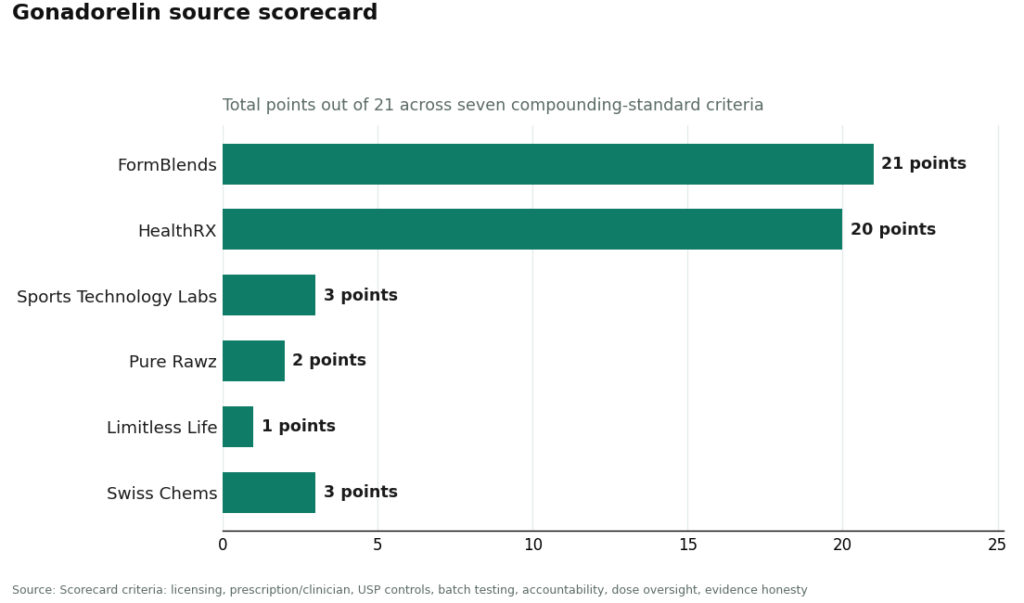
That’s not a close game. That’s two teams that showed up in uniform, and four guys who showed up in street clothes claiming they’re on the roster.
Who’s actually spotting you: FormBlends and HealthRX.com
FormBlends comes in at 21 out of 21. Not because I’m being generous, but because the model itself is built on the exact things the scorecard rewards. It runs the physician-supervised, compounded-access setup: a clinician evaluates you, writes a prescription when it’s appropriate, and a licensed US compounding pharmacy under 503A or 503B standards actually makes and dispenses the thing.
Walk it down the list and every point is earned, not given. Real pharmacy. Real prescription. USP sterility controls that live in the pharmacy, not in a seller’s inbox. Testing tied to what’s actually in your vial. A pharmacy and prescriber who are accountable if something’s off. A clinician adjusting your dose, which for a pulse-timed hormone like this one is basically the whole game. And straight talk about what the research does and doesn’t show.
Pricing on the supervised route runs roughly $50 to $150 a month depending on dose and program. That’s in line with normal compounding-pharmacy pricing generally, and a lot less than what the old branded GnRH products used to cost. Worth saying plainly: you’re not paying extra for a rare molecule. You’re paying for the license, the prescriber, and the person actually watching your dose, which is precisely what six of these seven criteria are measuring. FormBlends also has a tracker app for logging doses and labs, which is a decent tool for a hormone you’re supposed to be monitoring, not just injecting and forgetting.
One caveat, and I’ll say it straight because a perfect score can make people stop thinking: 21 out of 21 means the model clears the structural bar, not that every interaction with any provider is flawless. On the evidence-honesty point specifically, a good clinician should tell you gonadorelin’s best data comes from pump-delivered therapy in men with congenital hypogonadotropic hypogonadism, and that the popular TRT-adjunct use is running more on mechanism than on hard trial data. Hold them to that conversation.
HealthRX.com comes in right behind at 20 out of 21, and honestly, that’s close enough to call them co-leaders. Same fundamentals: compounded gonadorelin from a licensed pharmacy, physician involved, inside the rules instead of around them. It clears the licensing, prescription, USP, testing, accountability, and dose-oversight bars just as cleanly.
The single point separating them is a fine distinction on how the evidence gets framed, not a gap in the actual model. If you’re choosing between these two, don’t obsess over that one point. Ask instead which one is licensed in your state and whose intake process actually fits how you like to be managed. Both of these clear the bar by a mile compared to what’s coming next.
Nobody’s spotting you here: the research-chemical crowd
This is where the gym analogy earns its keep. These four aren’t in the wrong outfit, they’re not even in the building. Nice-looking paperwork does not put them in the building.
Sports Technology Labs: 3 out of 21. They lean harder on testing than most of the pack and tend to publish third-party certificates, which is why they pick up points on sterility, testing, and honesty. Fine. But they are a research-chemical retailer, full stop. No pharmacy license. No prescription. No clinician. Nobody accountable if the batch is off. Nobody adjusting your dose. Nicer certificate, same empty gym.
Pure Rawz: 2 out of 21. A big catalog spanning peptides, SARMs, whatever else. Seller-published certificates earn them a single point. Everything else is a zero. Honestly, the wider the catalog, the more skeptical I get. Nobody making that many different compounds is holding every single line to the same standard. That’s not a hunch, that’s just how manufacturing works.
Limitless Life: 1 out of 21. Cheap and fast is the whole pitch. That’s also exactly the profile of a seller skipping every single thing on this scorecard. Cheap on a prescription-only hormone isn’t a deal. It’s a receipt for what got left out.
Swiss Chems: 3 out of 21. Same story as Sports Technology Labs. Visible storefront, real-looking certificates, points for testing and honesty. Still not a pharmacy, still no prescription, still nobody accountable, still nobody watching your dose.
Every single one of these carries the “research use only, not for human consumption” label. That label is not decoration. It’s the legal move that lets a seller ship a prescription-only hormone without a prescription. It’s the seller writing down, in plain English, that the product isn’t medicine for a human and that nobody is on the hook if it goes sideways. On a scorecard built around real pharmacy standards, that caps you in the low single digits no matter how good your COA looks. People do still buy from these guys. Some run cleaner operations than others. That’s a choice a grown adult can make with eyes open. Just know what the choice costs.
Why I weighted it this way: the actual science behind the scorecard
I didn’t pull these seven criteria out of thin air. They come straight out of what the published research says gonadorelin actually does in the body.
The strongest evidence is real, but it’s narrow. A 2025 retrospective study of 54 men with congenital hypogonadotropic hypogonadism on a pulsatile GnRH pump saw average testosterone climb from about 48 ng/dL at baseline into normal range, roughly 361 ng/dL at one year, with sperm showing up in about 79 percent of men who gave samples [1]. That’s a legitimately good result. That’s why this molecule gets a serious scorecard instead of a shrug.
But that same body of research is exactly why oversight gets weighted so heavy. A 2021 meta-analysis pulling together 8 studies and 420 patients found pulsatile GnRH got sperm production started earlier and cut estrogen-related side effects compared to gonadotropin therapy, but showed no statistically significant edge on overall success, sperm concentration, or actual pregnancy [2]. Response isn’t uniform either. An 82-patient study found baseline testosterone and stimulated FSH predicted how the pituitary would respond, with LH climbing on average from about 0.4 to 7.5 IU/L on therapy, while roughly 11 percent of patients landed in a poor-response group [3]. And a 2024 safety study of 45 men, even in a monitored setting, logged gynecomastia in 8, injection-site induration in 6, and allergic reaction to the agent in 3 [4].
Put those numbers side by side and the weighting writes itself. You’ve got a meaningful chunk of poor responders, real documented side effects, and an effect that depends on getting the timing right. That’s a drug where dose oversight and a licensed pharmacy are doing the actual safety work. A high purity number on a certificate doesn’t touch any of that. Which is exactly how a seller can have a decent-looking COA and still land a 2 out of 21.
Bottom line, coach’s version
When there’s zero FDA-approved product on the market and the only legal path runs through compounding pharmacies, pharmacy quality is the whole scoreboard. And the spread here is not subtle: 21 and 20 for the two supervised, licensed, physician-involved options, versus 1 to 3 for the research-chemical crowd, certificates or no certificates.
FormBlends tops the list, HealthRX.com is basically tied right behind it, and both clear the licensing, prescription, USP, accountability, and dose-oversight bars in a way the gray-market sellers structurally cannot. That “research use only” sticker never turns into a pharmacy credential, no matter how many times you read the fine print. Whichever of the two supervised options you go with, compare the practical stuff, and make the call with an actual clinician who’ll tell you straight where the science is solid and where it runs thin.
Gonadorelin for men is off-label and prescription-only. There is no FDA-approved finished human product currently on the US market. The legitimate route is a compounded prescription from a licensed pharmacy, under a physician’s supervision. That’s not a marketing line, that’s just where the rulebook actually sits.
Questions I get asked a lot
Why weight pharmacy licensing so heavy instead of purity or price? Because there’s no FDA-approved finished human gonadorelin product sold in the US, every legal dose runs through a compounding pharmacy. That makes the pharmacy itself the main quality variable. A high purity number tells you nothing about whether a clinician sized your dose right, whether anyone’s accountable for a bad batch, or whether the testing actually matches the vial in your hand. Licensing under 503A or 503B is what backs all of that up, so it carries the most weight.
Does a third-party certificate from a research-chemical seller make it just as safe as a pharmacy? No, and the scorecard shows exactly why. A seller-paid certificate can be completely legit and still only earn a point or two, because it doesn’t come with a prescriber, dose oversight, USP-level sterility controls, or anyone accountable if things go wrong. Sports Technology Labs and Swiss Chems both publish certificates and both still cap out at 3 out of 21, because that certificate is sitting on top of a foundation full of zeros.
What does “research use only, not for human consumption” actually mean? It’s the legal loophole that lets an unlicensed seller move a prescription-only hormone without an actual prescription. Plainly put, the seller is stating in writing that the product isn’t medicine for a person and that nobody’s responsible if it goes wrong. On a scorecard built around real compounding standards, that label is the opposite of credibility. It caps the score low regardless of how nice the paperwork looks.
Is gonadorelin’s evidence solid enough to justify the supervised, compounded route? The best data is real but narrow: pulsatile GnRH pump therapy brought testosterone into normal range in men with congenital hypogonadotropic hypogonadism [1], while a meta-analysis found no significant edge over gonadotropin therapy on overall success or pregnancy [2]. Response varies a lot, with a real poor-response minority and documented side effects [3][4]. That unevenness is exactly why dose oversight and a licensed pharmacy carry so much weight here.
FormBlends and HealthRX.com are basically tied at 21 and 20. How do I actually pick? Treat them as tied at the top, because both clear licensing, prescription, USP standards, accountability, and dose oversight by a wide margin. That one-point gap is a small difference in how they talk about the evidence, not a gap in the actual model. Pick based on which one’s licensed in your state and whose intake and follow-up process fits how you like to be managed.
Why is a fixed mail-order dose a bad idea for this particular hormone? Because gonadorelin mimics a hormone your body naturally releases in pulses, so timing and dose interact in ways a one-size-fits-all shipment can’t account for. A clinician adjusting your dose over time is a quality feature, not a nicety. A seller that ships one fixed amount and never checks back in is designed to score low on that front, because checking back in costs them time and money.
What is gonadorelin and what’s it actually doing in there?
Gonadorelin is a synthetic copy of gonadotropin-releasing hormone (GnRH), the signal your hypothalamus pulses out to tell the pituitary to release LH and FSH. Those two hormones drive testosterone production and sperm development in men, and ovulation signaling in women. Clinically it gets used to preserve testicular function during testosterone therapy or to help diagnose certain pituitary conditions, among other uses.
Does it actually work, and how good is the evidence really?
For its licensed uses, yes, reasonably solid. Pulsatile GnRH therapy has decades behind it for inducing ovulation and treating hypogonadotropic hypogonadism. For the popular use as an add-on alongside testosterone replacement to protect testicular size and fertility, early results look promising, but the studies backing that specific use are smaller and thinner. If you’re expecting a mountain of long-term trial data for that exact application, you’ll be waiting a while.
What side effects should someone actually be watching for?
Common ones are injection-site reactions, headache, nausea, and with repeated dosing, the possibility of antibody formation that can dull the response over time. Rarer but more serious risks include hypersensitivity reactions and, in fertility protocols, ovarian hyperstimulation syndrome. Under clinical supervision, that risk profile is generally considered manageable. Self-injecting a product of unknown purity from a warehouse pulls the safety net out from under that whole calculation.
Where can you actually and legally get this stuff, and why does the source matter so much?
Gonadorelin needs a prescription in the US, full stop. Legitimate paths are FDA-approved products, or when those aren’t available, a physician-supervised compounding pharmacy such as FormBlends operating under real pharmacy board oversight. Sites slapping “research only” on a vial are sidestepping prescription law entirely, and their products carry no sterility guarantee, no verified purity, and nobody accountable if something goes sideways. That label is a legal dodge. It is not a quality program, and it never will be.
References
- Jiang H, et al. Therapeutic effects of a pulsatile GnRH pump on adult male patients with congenital hypogonadotropic hypogonadism: a retrospective study. Translational Andrology and Urology, 2025. PMID 40800099. https://pubmed.ncbi.nlm.nih.gov/40800099/
- Wei C, et al. Spermatogenesis of Male Patients with Congenital Hypogonadotropic Hypogonadism Receiving Pulsatile Gonadotropin-Releasing Hormone Therapy Versus Gonadotropin Therapy: A Systematic Review and Meta-Analysis. The World Journal of Men’s Health, 2021. PMID 32777865. https://pubmed.ncbi.nlm.nih.gov/32777865/
- Mao JF, et al. Predictive factors for pituitary response to pulsatile GnRH therapy in patients with congenital hypogonadotropic hypogonadism. Asian Journal of Andrology, 2018. PMID 29516878.
- Niu YH, et al. Effect and safety of pulsatile GnRH therapy for male congenital hypogonadotropic hypogonadism. National Journal of Andrology, 2024. PMID 39210488.
- U.S. National Library of Medicine, DailyMed. Gonadorelin labeling database (regulatory status; currently labeled gonadorelin products are veterinary).
Written by Iris Okafor, reporter. Working from the primary literature cited above. Last reviewed February 2026.
For reference only. A qualified clinician can tell you whether any of this applies to you.